
DynamoDB alternatives: choose by why you're leaving

Written by Rafal Wilinski
Published: October 23rd, 2026
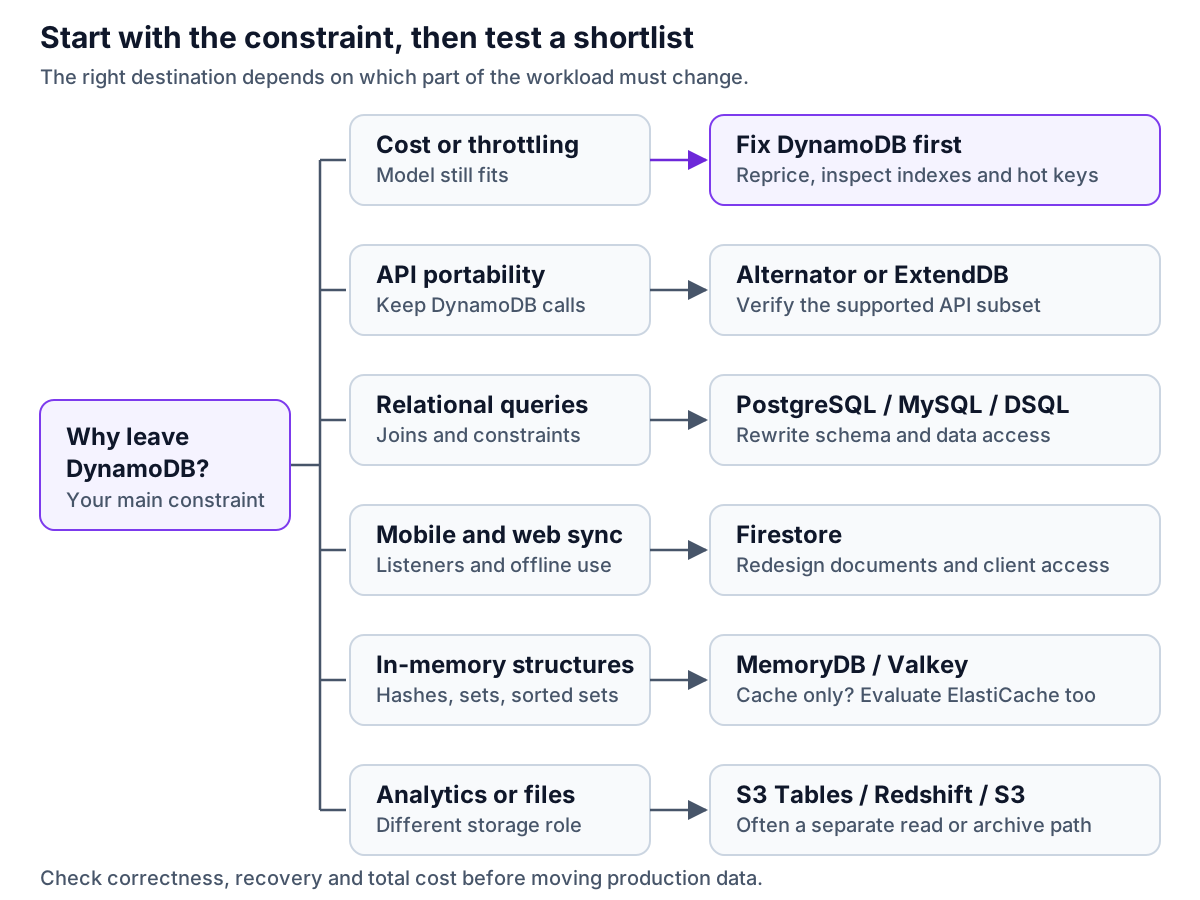
The best DynamoDB alternative depends on what needs to change: PostgreSQL or MySQL for a relational model, MongoDB for document queries, Firestore for mobile synchronization, or ScyllaDB Alternator and ExtendDB when retaining the DynamoDB API matters. MemoryDB and Valkey suit applications built around in-memory data structures; Bigtable suits large workloads organized around row keys. If cost or a missing access pattern is the problem, first reprice and re-index DynamoDB before paying for a migration.
The recommendations below are workload shortlists, not benchmark rankings. Product documentation and billing models were checked on October 23, 2026. Migration effort describes application and operational changes, not a promise about how many days the work will take.
Which DynamoDB alternative fits your workload?
| Why you are leaving | First alternative to evaluate | Why it fits | Migration effort |
|---|---|---|---|
| High bill or repeated throttling | Fix DynamoDB first | Capacity, indexes and key distribution may be the actual problem | Low for configuration; higher for key redesign |
| Keep DynamoDB calls outside AWS | ScyllaDB Alternator or ExtendDB | Implements a DynamoDB-compatible API | Lower API rewrite; substantial compatibility and operations testing |
| Joins, constraints and changing query patterns | PostgreSQL, MySQL or Aurora PostgreSQL | Relational schema and SQL | High: queries, schema, transactions and data conversion |
| Distributed SQL without operating a cluster | Aurora DSQL or Google Spanner | Managed distributed relational databases | High: SQL model, transaction behavior and client changes |
| Document queries across cloud providers | MongoDB Atlas | Document model and a managed deployment choice across clouds | High: MongoDB driver, indexes and query rewrite |
| Direct mobile/web synchronization | Firestore | Client SDKs, listeners and offline support | High: client access, security rules and document model |
| Azure-native application | Azure Cosmos DB | Azure-managed data distribution and APIs | High: partitioning, queries and identity |
| Large time-ordered datasets accessed by row key | Google Bigtable | Wide-column storage and row-range access | High: row-key, column-family and client redesign |
| A durable database using Valkey commands | Amazon MemoryDB | In-memory data structures with a durable transaction log | High: command and data-model rewrite |
| Faster repeated reads | ElastiCache or a self-managed Valkey cache | Cache a working set while retaining the source database | Medium: invalidation and cache-miss handling |
| Files, archives or analytical tables | S3, S3 Tables or Redshift | Object storage or analytical processing | High if replacing application reads; lower as a separate read path |
The sections below link the official documentation behind these choices and explain the cost model. For an open-source DynamoDB alternative, decide whether you mean open-source software, a DynamoDB-compatible API, or simply a database you can host yourself. Those requirements produce different shortlists.
Before you leave: can DynamoDB solve the problem?
Recalculate cost using current prices
Comparisons using pre-November 2024 on-demand prices are obsolete. AWS cut on-demand throughput prices by 50%, effective November 1, 2024. That does not mean every part of a DynamoDB bill halved: storage, backups, indexes and replication must still be modeled. See the AWS price-cut announcement and the DynamoDB pricing calculator.
Check these options before comparing DynamoDB with a cluster's advertised hourly price:
- Standard-IA: lower storage rates, higher read/write rates. It suits infrequently accessed data when the storage savings exceed the throughput premium. Use AWS's table-class guidance.
- Provisioned and reserved capacity: predictable traffic may justify provisioned capacity; reserved capacity applies to eligible provisioned Standard-class capacity, not on-demand requests.
- Database Savings Plans: a one-year spend commitment can discount eligible DynamoDB throughput. Reserved capacity applies first; the same usage does not receive both discounts. Compare the eligible usage and commitments on DynamoDB pricing.
Compare equivalent redundancy, backups, support and staff time. A mostly idle cluster and a heavily utilized cluster have different economics. A migration proposal should include both normal and peak traffic, plus the temporary cost of operating two databases.
Separate query syntax from query capability
An extra access pattern may need a global secondary index. GSIs now support up to four partition-key attributes and four sort-key attributes. That reduces synthetic-key concatenation, but queries still require equality on all partition components and follow the sort-key order. See the multi-attribute key pattern.
PartiQL provides SQL-like syntax over DynamoDB's existing model. It does not turn the database into a relational join engine, and a SELECT without a suitable partition-key condition can still scan the table. AWS documents that behavior in its PartiQL SELECT reference.
Search and analytics can be separate read paths. The OpenSearch zero-ETL integration loads a snapshot and then follows Streams. The Redshift integration refreshes through incremental exports, typically every 15 to 30 minutes. Destination and integration costs remain. Read DynamoDB vs Redshift if analytical SQL is the missing capability, and DynamoDB vector search before migrating solely for similarity search.
For latency or throttling, identify whether time is spent in the client, network, retries or database. A hot partition needs a different remedy from an undersized table quota. Moving an unchanged hot-key workload to another distributed database is not evidence that the problem is solved.
Which alternatives preserve the DynamoDB API?
API compatibility can preserve many calls in your data-access layer. It does not automatically preserve IAM policies, Lambda integrations, backup APIs, billing behavior or failure semantics. Inventory the exact operations your application uses before changing an endpoint.
ScyllaDB vs DynamoDB: Alternator is the API-compatible route
Alternator implements the DynamoDB API on ScyllaDB. Evaluate it when you want control over where the database runs while retaining DynamoDB request shapes. A plain ScyllaDB CQL migration is a different project and requires rewriting database calls.
ScyllaDB's compatibility documentation lists important gaps: TransactWriteItems and TransactGetItems are unsupported, as are PartiQL and DynamoDB's continuous-backup APIs. It also requires an explicit write-isolation policy and a load-balancing arrangement. An application built around multi-item transactions cannot move by changing its endpoint alone.
Migration effort is moderate only when the used API subset matches; otherwise it rises sharply. Budget cluster resources and operations for self-managed deployments, or the managed service and support for ScyllaDB Cloud. Do not describe current ScyllaDB as unrestricted open source: its licensing FAQ distinguishes current source-available releases from the final AGPL open-source line and documents free-tier eligibility.
ExtendDB: an open-source adapter, with deployment limits
ExtendDB is an Apache-2.0 DynamoDB-compatible adapter managed as an independent AWS open-source project. PostgreSQL is its default storage backend. It is worth evaluating for on-premises, edge, air-gapped or multi-cloud requirements where the DynamoDB protocol is already embedded in an application.
Check its differences from DynamoDB, rather than treating the compatibility claim as full service equivalence. Global Tables and PartiQL are not implemented. The deployment guide currently supports one server instance per catalog; multiple instances behind a load balancer are unsupported, and the health endpoint does not test database connectivity.
The software license has no per-request charge; the backend, hosting, backups and operating work still cost money. Expect compatibility testing plus responsibility for the adapter and storage backend. Prototype recovery and availability before choosing it for a production system that previously relied on DynamoDB's managed operation.
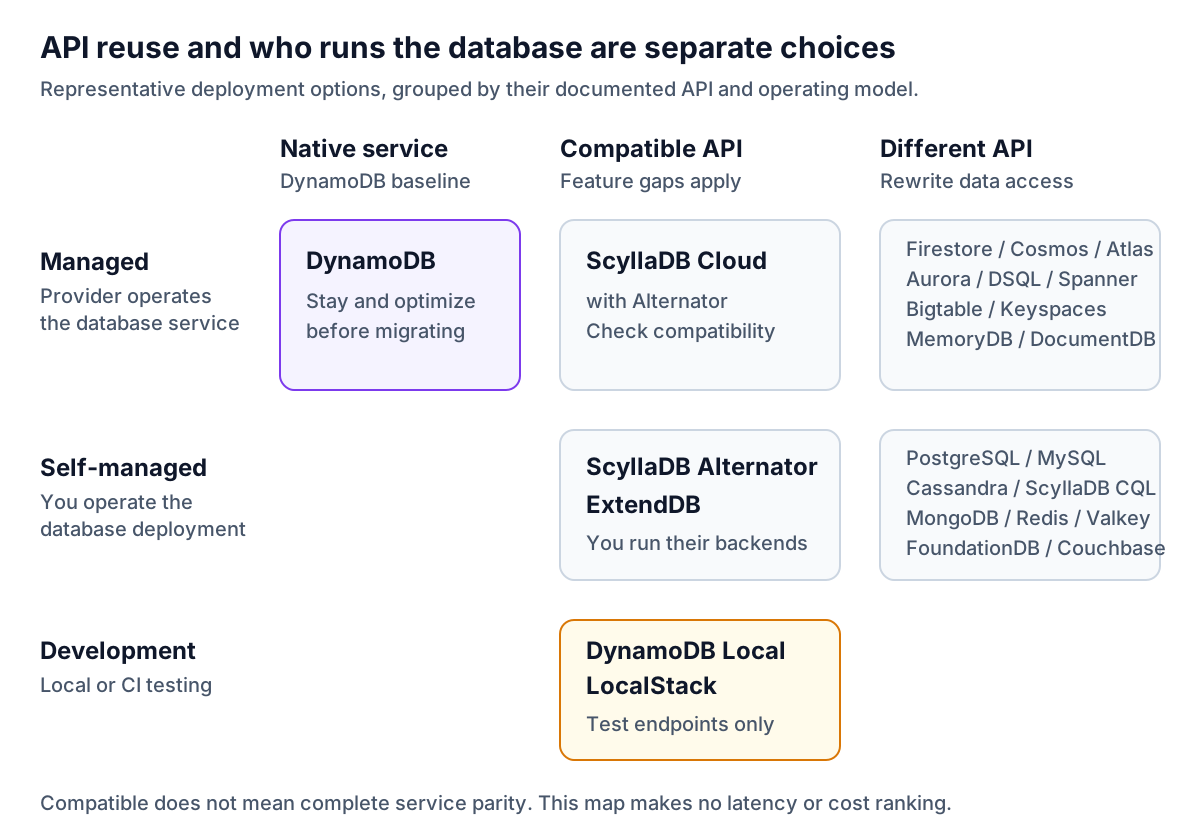
The map classifies deployment choices, not speed or feature completeness. A managed ScyllaDB deployment and a self-managed one appear separately because the operational responsibility changes even when the API does not.
Development-only alternatives: DynamoDB Local and LocalStack
DynamoDB Local runs on your machine for development and testing without DynamoDB service charges. Migration effort for a local test harness is usually endpoint and test-data configuration. It is not an alternative production service or a production performance benchmark.
LocalStack's DynamoDB emulator is useful when a test needs DynamoDB alongside other emulated AWS services. Its cost model is a LocalStack subscription, with plan and non-commercial eligibility restrictions, plus your local or CI compute. Test coverage and deployment behavior must be checked for the services you use.
Dynobase can browse DynamoDB Local and LocalStack through its local admin GUI. That helps inspect test data while keeping the production database decision separate.
Other AWS services: change the model, keep the cloud
DynamoDB vs MySQL, Aurora PostgreSQL and Aurora DSQL
Choose a relational database when joins, constraints and independently evolving queries dominate the workload. For example, an order report that repeatedly combines customers, payments and refunds deserves a SQL prototype before another layer of application-side denormalization.
MySQL is a relational option you can run yourself or through a managed service. Its InnoDB engine supports ACID transactions and foreign-key constraints. Moving from DynamoDB is high effort: split denormalized items into tables where appropriate, write SQL, design indexes and translate conditional writes. Costs are infrastructure and operations for self-hosting, or the chosen managed plan. DynamoDB vs Amazon RDS explains the managed relational route.
Aurora PostgreSQL provides a managed PostgreSQL-compatible relational engine. Aurora documentation describes its relationship to RDS and its MySQL and PostgreSQL compatibility. The migration still requires SQL and schema work. Pricing combines provisioned compute or serverless capacity, storage and applicable I/O, backup and transfer charges. Compare DynamoDB vs Aurora for the broader tradeoff.
Aurora DSQL is a separate serverless distributed relational service, not another name for Aurora PostgreSQL. Evaluate it for a SQL transactional application that needs managed distributed operation. Its PostgreSQL compatibility uses PostgreSQL clients but has its own supported-feature and concurrency rules. Migration effort is high from DynamoDB. DSQL pricing meters database work in Distributed Processing Units plus storage; failed or aborted transaction work can also be billed.
Keyspaces and DocumentDB
| Service | When to evaluate it | Work to migrate | Pricing model |
|---|---|---|---|
| Amazon Keyspaces | You specifically want a managed Cassandra-compatible database and its query model | High from DynamoDB: CQL, schema, keys and driver changes. Read DynamoDB vs Keyspaces. | On-demand or provisioned reads/writes, storage and applicable backup/replication charges |
| Amazon DocumentDB | Document access through supported MongoDB APIs while staying with an AWS-managed service | High: driver, indexes and query rewrite. Check the supported APIs; MongoDB compatibility is not identical feature coverage. See DynamoDB vs DocumentDB. | Compute, storage, backup and applicable I/O, depending on cluster configuration |
Neither preserves the DynamoDB API. Choose Keyspaces because the Cassandra ecosystem helps your application, or DocumentDB because the supported document operations fit it, not simply because both are called NoSQL.
MemoryDB vs DynamoDB, and where ElastiCache fits
Amazon MemoryDB is a durable in-memory database compatible with Valkey and Redis OSS. It persists writes through a Multi-AZ transaction log. Evaluate it for a primary database whose access patterns map naturally to those commands and data structures. Rewriting DynamoDB operations and sizing the working set make this a high-effort migration. Costs include nodes, billable data written, snapshots and applicable transfer; engine-specific allowances matter.
ElastiCache supports Valkey, Redis OSS and Memcached in serverless or node-based deployments. For repeated reads, adding a cache may be enough: keep DynamoDB as the source of truth and implement invalidation and cache-miss handling. That is a medium-effort application change rather than a full data migration. Pricing uses serverless storage and processing units or provisioned nodes, with other applicable charges. See DynamoDB vs ElastiCache.
S3 and S3 Tables
Use S3 for objects such as files and immutable archives, potentially keeping their metadata in DynamoDB. S3 Tables stores Apache Iceberg tables for analytical query engines. Neither is a direct replacement for application-level GetItem and conditional-update semantics.
Moving an archive is less work than redesigning online application reads around objects or analytical tables. S3 pricing includes storage, requests and applicable transfer; S3 Tables adds management and compaction dimensions, and the query engine has its own bill. Read DynamoDB vs S3 before comparing storage rates alone.
Other clouds and managed document databases
Moving providers changes identity, networking and operations as well as database calls. It does not by itself create a portable application. All five routes below require a substantial query or data-model migration from DynamoDB.
Azure Cosmos DB
Cosmos DB is a managed Azure database offering multiple APIs, distributed data and configurable consistency. It is a candidate when the application belongs in Azure and its selected API matches your queries. Choose the API first, then prototype partition keys and indexes; do not translate DynamoDB capacity units directly into Cosmos DB request units.
The billing documentation describes provisioned request units per second or serverless request-unit consumption, plus storage, for its RU-based offerings. See DynamoDB vs Cosmos DB.
Firebase vs DynamoDB: compare Firestore specifically
Firebase is a product suite; Cloud Firestore is the relevant document database when you want mobile/web SDKs, real-time listeners and offline synchronization. Those features make it worth evaluating for collaborative or intermittently connected apps. The migration includes document layout, indexes, client access and authorization rules, not just backend queries.
For Firestore Standard edition, billing covers document operations, applicable index-entry reads, storage and network use. Listener updates can generate read charges. Read DynamoDB vs Firestore. If an existing application uses the Datastore API, also see DynamoDB vs Google Datastore and Google's Firestore API selection guidance.
Bigtable vs DynamoDB
Google Bigtable is a wide-column database for large datasets organized by row key, including time-series-style access patterns. Evaluate it when ordered row-range access is central to the workload. Migration means choosing row keys and column families and rewriting clients; do not assume a DynamoDB GSI has a direct equivalent in your new schema.
The pricing model includes provisioned nodes, storage and network use, with additional features billed separately. Benchmark the actual row distribution and traffic shape. A large dataset alone does not establish that Bigtable will be cheaper or faster. See our DynamoDB vs Bigtable comparison.
Spanner
Google Spanner combines relational capabilities with distributed operation. Its external consistency documentation describes transaction ordering guarantees. Evaluate it when distributed relational transactions are a requirement, then test contention and transaction retries under your workload.
Expect a schema and query rewrite from DynamoDB. Pricing includes compute capacity, database storage, backups and applicable networking, with edition and regional differences. Read DynamoDB vs Spanner.
MongoDB Atlas and Couchbase
MongoDB Atlas operates MongoDB on AWS, Azure or Google Cloud. It is a candidate when document queries fit better than DynamoDB's key-oriented access patterns and you want managed infrastructure with cloud choice. Replace the DynamoDB driver, remodel documents and rebuild indexes; AWS integrations need their own replacements. Atlas billing depends on deployment type and includes cluster or usage charges and applicable extras. Start with DynamoDB vs MongoDB.
Couchbase Server combines JSON documents, key-value operations and SQL++ queries. Evaluate it when that combination fits your application. Migration requires Couchbase SDK calls and index/query design. Self-managed costs include infrastructure and edition/support costs; managed Capella bills by cluster size and number.
Self-managed and open-source DynamoDB alternatives
Hosting the database yourself transfers backups, capacity planning, upgrades and recovery to your team. For the options below, budget infrastructure and operating time, plus any edition or support charges. Except for ScyllaDB through Alternator and ExtendDB, plan on replacing DynamoDB clients and query logic.
| Database | When it is worth the operating work | Migration consequence |
|---|---|---|
| PostgreSQL | Open-source relational storage when SQL and data integrity rules simplify the application | High: normalize where useful, create SQL indexes and translate writes. See DynamoDB vs PostgreSQL. |
| Apache Cassandra | Open-source distributed wide-column storage when you want to operate the deployment | High: CQL and partition-oriented modeling, plus cluster administration. See DynamoDB vs Cassandra. |
| ScyllaDB | Deployment control, with the choice of its native CQL interface or the Alternator compatibility layer | High for a CQL rewrite; API-dependent for Alternator. Current source-available license conditions still apply. |
| MongoDB | Document querying with control over the deployment | High: documents, indexes, drivers and replica operations. Check its SSPL terms, rather than equating self-hosting with a permissive license. |
| Redis or Valkey | In-memory data structures such as hashes, sets and sorted sets | High for primary storage; medium for adding a cache. Design persistence, eviction and recovery explicitly. See DynamoDB vs Redis. |
| FoundationDB | An ordered key-value core with ACID transactions when you are prepared to build a data layer | High: design key encoding, indexes and application APIs or adopt a suitable layer. This is a database-building foundation, not a DynamoDB SDK endpoint. |
PostgreSQL, Cassandra, Valkey and FoundationDB are open-source choices with different models. ExtendDB is the API-compatible open-source candidate discussed above. A license label says nothing about how closely failure handling or consistency matches DynamoDB.
Specialist alternatives and services to exclude
Some DynamoDB competitors solve a narrower problem. Use these comparisons when the workload calls for them:
- Aerospike: its record model supports namespaces with memory, SSD or hybrid storage configurations. Evaluate it for key-based workloads needing that storage control. Migration requires its SDK and data model; budget deployment resources and the chosen edition. See DynamoDB vs Aerospike.
- Amazon Neptune: a managed graph database is worth considering when relationship traversal drives the application. Graph modeling and query rewrites make migration high effort; compute, storage and applicable I/O drive the bill. See DynamoDB vs Neptune.
- Oracle NoSQL Database: its distributed key/value, JSON and table model is a candidate where Oracle's deployment and API choices are a requirement. Migration means different clients and schema decisions; cost depends on deployment and edition. See DynamoDB vs Oracle NoSQL.
- Memcached: an in-memory cache can serve disposable cached results, not the role of a durable system of record. Budget cache-miss and invalidation work and the machines running it, or a managed cache plan. See DynamoDB vs Memcached.
- Timestream: check service identity before choosing it for time-series data. AWS closed Timestream for LiveAnalytics to new customers on June 20, 2025. DynamoDB vs Timestream explains the distinction; do not treat an old LiveAnalytics recommendation as a new-customer migration path.
If your shortlist already includes Neo4j, Elasticsearch or Snowflake, start with the focused comparisons: DynamoDB vs Neo4j, DynamoDB vs Elasticsearch and DynamoDB vs Snowflake.
Fauna's hosted service is not a current migration destination. Its archived end-of-life FAQ set May 30, 2025 as the service shutdown date. Do not carry it forward from older alternatives lists.
How do you migrate off DynamoDB?
Export a snapshot, then account for ongoing writes
AWS's export to S3 supports full and incremental exports, requires point-in-time recovery, and does not consume table read capacity. Output is DynamoDB JSON or Amazon Ion. It is a data extraction path, not a ready-made PostgreSQL dump or MongoDB backup. The S3 export walkthrough covers the starting point.
- Inventory behavior. Record keys, GSIs, condition expressions, transactions, TTL, Streams consumers, global replication and authorization. Replay representative successful and failed operations against the candidate.
- Define the destination model. Specify how Numbers, Binary values, sets, nested maps, absent attributes and
NULLmap to target types. Decide whether synthetic keys remain useful. Importing JSON without a type policy risks changing application behavior. - Load a consistent starting snapshot. Choose the export time and transform into the destination's supported import format. Measure import errors and validate representative queries and data values, not only row counts.
- Capture the gap. For a live migration, begin durable change capture before the snapshot boundary and retain it through backfill. Reconcile overlap with item versions or another explicit ordering strategy. A Streams-based consumer must handle deletes, retries and replay; DynamoDB Streams retains records for only 24 hours, so buffer beyond that window if the migration may take longer.
- Validate and cut over. Compare reads, test conditional-write conflicts and recovery, then briefly stop or coordinate writes to finish catching up. Define one authoritative writer and a rollback procedure. Two independent writes from application code are not an atomic cross-database transaction.
An offline migration can be simpler: stop writes, export, transform, validate and switch. Choose downtime deliberately instead of presenting an untested live pipeline as zero downtime.
Can AWS DMS use DynamoDB as a source?
DynamoDB is not listed as a supported AWS DMS source endpoint in the current source matrix. AWS documents DynamoDB as a DMS target. Do not plan a direct DynamoDB-to-PostgreSQL DMS replication task based on target support.
Export and transformation, a verified destination-specific migration tool, or a custom snapshot-plus-change-capture pipeline are the routes to assess. Our MongoDB-to-DynamoDB migration guide covers the opposite direction; reversing its DMS configuration does not create source support.
Common mistakes when choosing an alternative
- Calling API compatibility a complete migration plan. Test conditional failures, pagination, transactions and recovery, not just successful reads and writes.
- Comparing unequal operating models. Include replicas, backups, idle capacity, transfer, support and staff time in both estimates.
- Moving for syntax alone. SQL-like syntax is not evidence of relational semantics, and a different query language does not remove the need for index design.
- Using a cache or analytics store as an interchangeable database. Define the source of truth and required freshness before changing storage roles.
- Measuring only average latency. Compare tail latency during bursts, failures and recovery with realistic item sizes and key skew.
Frequently Asked Questions
What is the best DynamoDB alternative?
Is there an open-source DynamoDB alternative?
Can ScyllaDB replace DynamoDB without changing code?
Is Firebase an alternative to DynamoDB?
Is MemoryDB better than DynamoDB?
Can AWS DMS migrate data out of DynamoDB?
Dynobase is a Professional GUI Client for DynamoDB
Start your 7-day free trial today